SPOILER PAGE FOR CELLO
Here's what I thought gave the twist of the movie away only minutes after it started:
In Cello's pre-credit sequence, we see a woman wheeled into an emergency room after a particularly brutal accident. We don't get a very good look at her, since she's covered with blood and wearing an oxygen mask; and in any case, we have no context yet through which to identify her. Once the movie really gets started, people who are more observant than I am could probably figure out that the woman is actually our heroine, Mi-Joo... from the style of her clothing, if nothing else; but the movie goes on to hint that this sequence is back-story, and that the dying woman might be Tae-yeon.
Eventually, the woman's struggles for life subside, and the EKG goes flat:
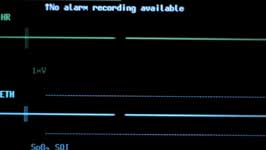
Fast forward a few minutes: Mi-Joo is in her car, and she's just put Tae-yeon's cassette in her tape player. The recording has a powerful effect on Mi-Joo: the scars on her wrist start to pulse, and she finds herself unable to concentrate on the road ahead. She starts to lose control of the car, which pulls to the left... though we can't really tell if it's because she's subconsciously reliving the accident that killed Tae-yeon, as we'll see later, or if the car is drifting because the angry student had punctured the tire... In any case, the car swerves across the divider, right into the path of an oncoming bus...
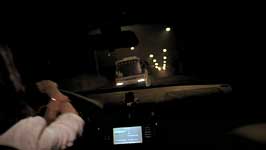
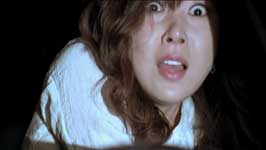
Cut to black. For four seconds, we see nothing.
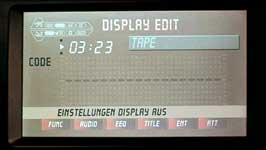
When the image returns, we see the graphic frequency display on Mi-Joo's tape player. The music stops, and the display goes flat:

Well? What do you think has happened?
To me, it couldn't be much clearer what the tape player is supposed to represent: it's a visual echo of the EKG... which is still fresh in our minds, since it's been less than ten minutes since we saw the pre-credit sequence. Mi-Joo was the girl in the accident, not Tae-yeon. Regardless of what follows — as we see Mi-Joo regain her composure, eject the tape and drive home — we know what's really going on...
She's dead.
It wasn't a near-miss after all. There's been a terrible accident; Mi-Joo is rushed to the hospital, as we saw in the opening (and as we'll see at the end), and her heart stops. Everything that comes after the black screen is Mi-Joo's subjective reality, with one of the following explanations:
1. Mi-Joo is really dead, and the rest of the story is either her dying hallucination — her guilty conscience punishing her as her synapses misfire and flicker out, in the manner of Jacob's Ladder — or some sort of never-ending punishment in the afterlife, like the spinning wheel at the end of Nakagawa's Jigoku.
OR...
2. The doctors have indeed managed to start her heart again, and she is in some sort of coma. This is actually the explanation the film suggests on the surface, as Mi-Joo hears her husband's voice at odd intervals, telling her to abre los ojos wake up. Then the film's Dead of Night circular ending could be understood as either the real haunting getting started after she's awakened... or a sign that she still hasn't come out of the coma, and that her mind is still tormenting her with images of guilt and punishment. You can also see her "coma" as a false hope that she can escape her eternal punishment, when in fact she is dead and facing her hellish afterlife; see option 1 again.
Much to the film's credit, it allows us to accept either explanation; and in fact, I think the most satisfying conclusion to the film is to accept both (or neither).
I should point out that during the course of the movie after the accident, we see a number of things from outside Mi-Joo's experience. If the narrative really is unfolding in Mi-Joo's broken mind, we shouldn't be able to see these bits. These sequences may make us question whether our instincts about the accident scene were correct; but when we find out the truth, we realize the director's been a little less than fair with us in constructing his story. But that's not my main problem with the way the narrative is laid out. I'm more upset by the fact that I've been told so explicitly what to expect. It's like a puppeteer leaning down from the scaffolding to show the audience his hands holding the strings. It's like a magician winking at the audience and showing them the flowers up his sleeve before he pretends to pull them out of a handkerchief. And it could have been avoided so simply...